A Practical Guide to Marketing for Ecommerce Growth
At its core, marketing for e-commerce is all about getting the right people to your online store and making it an absolute pleasure for them to buy something. It’s a blend of different strategies—from getting found on Google with search engine optimisation (SEO) to running clever ad campaigns and sending emails that people actually want to open. The real magic happens when all these pieces work together, creating a seamless path that turns a first-time visitor into a lifelong fan.
At its core, marketing for e-commerce is all about getting the right people to your online store and making it an absolute pleasure for them to buy something. It’s a blend of different strategies—from getting found on Google with search engine optimisation (SEO) to running clever ad campaigns and sending emails that people actually want to open. The real magic happens when all these pieces work together, creating a seamless path that turns a first-time visitor into a lifelong fan.
Building Your E-commerce Marketing Blueprint
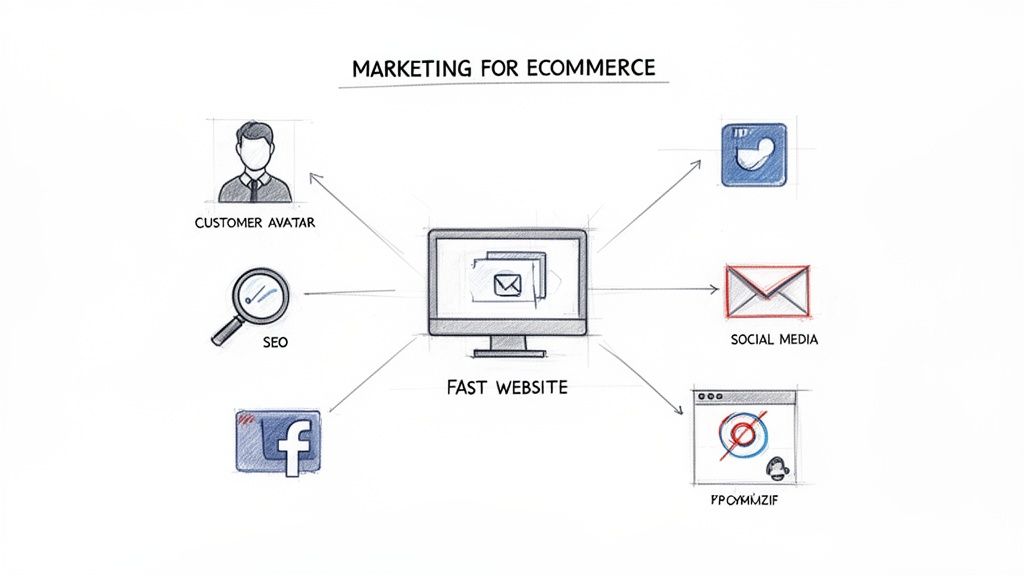
Jumping into marketing for e-commerce can feel like trying to drink from a fire hose. The key is to step back and draw up a blueprint first. This isn't about throwing tactics at the wall to see what sticks; it's about building a solid, interconnected system where every single marketing effort fuels the next, creating a powerful growth engine for your store.
And where does this blueprint start? Not with a flashy ad, but with a simple, fundamental question: who are you actually selling to?
Define Your Customer Avatar
A customer avatar (you might also hear it called a buyer persona) is a super-detailed profile of your perfect customer. Forget basic demographics like age and location for a moment. We're talking about their real-life challenges, what gets them excited, where they hang out online, and what makes them tick. You're essentially creating a fictional character who embodies your ideal buyer.
To bring this person to life, dig into questions like:
- What pain point does your product solve for them?
- Which social media platforms, blogs, or forums do they live on?
- What kind of content do they trust and engage with?
- What’s holding them back from clicking "buy now"?
Once you have this avatar clear in your mind, every other marketing decision becomes a hundred times easier. It dictates your brand's tone of voice, the channels you invest in, and the kind of offers that will truly resonate.
Map the Customer Journey
Now that you know who you're talking to, you need to understand how they buy. The customer journey is the map of their entire relationship with your brand, from the very first time they hear your name to the moment they become a loyal, repeat customer. This framework is crucial for saying the right thing at the right time.
A well-defined customer journey turns marketing from a series of random actions into a guided conversation. It allows you to anticipate customer needs at each stage, building trust and momentum toward a sale.
The Overlooked Foundation A Fast Website
Here’s a hard truth: all your brilliant SEO, paid ads, and email campaigns eventually lead to one place—your website. If that website is slow, clunky, or confusing, you’ve just wasted all that time and money. Technical performance, especially page speed, is no longer just an IT issue; it’s a cornerstone of modern marketing for e-commerce.
A common culprit for a sluggish site? Huge, unoptimised product images. Fixing this isn't just a technical tweak; it's a massive marketing win. Think about it: research shows that e-commerce stores with a smart, multi-channel strategy see an average of 25-40% higher customer lifetime value than shops stuck on a single channel. A fast, smooth website is the hub that makes that entire multi-channel strategy possible. For a deeper dive, check out these customer experience findings from McKinsey. A faster website also directly impacts your Google ranking by improving your Core Web Vitals.
Guiding Customers From First Glance To Firm Favourite
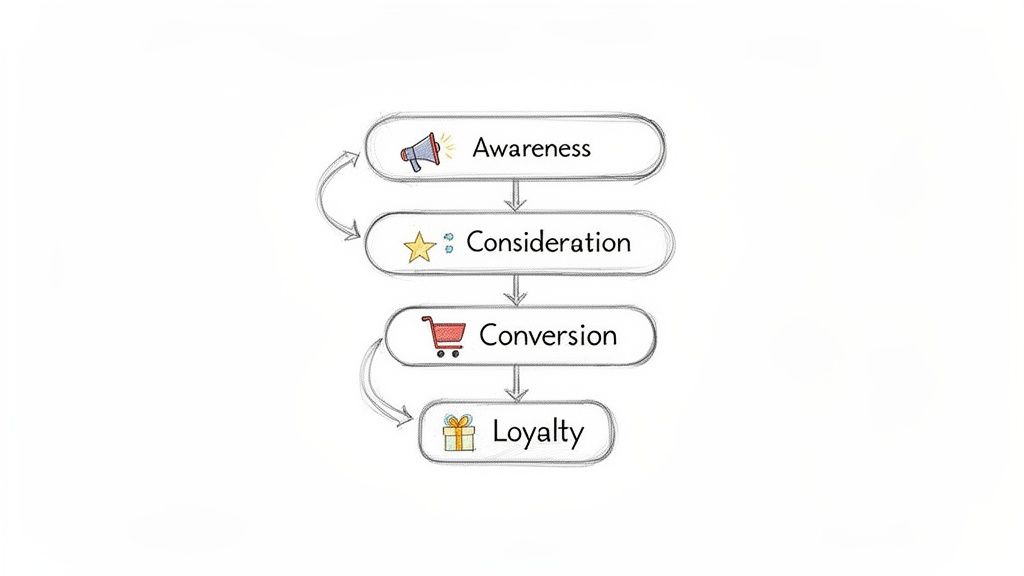
Great marketing for ecommerce isn't about a single, show-stopping ad. It's more like a thoughtful conversation. You meet people where they are and gently guide them from that first "hello" all the way to becoming a loyal fan who tells their friends about you.
We can map this journey using a classic four-stage funnel. Thinking this way helps you say the right thing at the right time, so you're not pushing for a sale before you've even earned a sliver of trust.
Stage 1: The Awareness Stage
Think of this as the top of your funnel—it's your brand's first impression. You're reaching out to people who likely have no idea you even exist. The goal here is simple: discovery. They aren't actively shopping; they're scrolling, learning, or just looking for something interesting.
Your job is to create content that’s genuinely helpful or intriguing, solving a problem or sparking a little bit of curiosity. This is not the place for a hard sell. Instead, you'll want to focus on:
- Content Marketing: Publishing useful blog posts or guides that answer questions your ideal customer might be Googling.
- Social Media: Creating eye-catching, shareable content that shows off your brand's personality. Think beautiful lifestyle shots on Instagram or Pinterest. Getting this right includes making sure your shared links look great—our guide on creating the perfect OG image size can help with that.
Stage 2: The Consideration Stage
Okay, so they know who you are. Now what? They've entered the consideration stage, where they're actively researching and weighing their options. Your mission is to build trust and show them exactly why your product is the answer they've been looking for.
This is where you can start talking more about your products. Credibility is everything here. Your tactics should include:
- Compelling Product Pages: Don't just list specs. Use high-quality photos, write detailed descriptions, and focus on the benefits—how will this product make their life better?
- Social Proof: Let your happy customers do the talking. Display authentic reviews and testimonials where people can easily see them. It works—according to Statista, 60% of people buy based on what they see from brands on social media.
- Email Marketing: Offer a small discount for a newsletter sign-up. Then, send them genuinely useful emails that build on your brand's value and expertise, not just constant sales pitches.
Stage 3: The Conversion Stage
This is it—the moment of truth. A potential customer is ready to buy, and your only job is to make it as easy as humanly possible. Any friction now, whether it's a confusing form or a surprise shipping cost, can send them running for the hills.
Your checkout process should be invisible. The less a customer has to think about the steps, the more likely they are to complete the purchase. Every extra field or confusing instruction is a potential exit point.
To seal the deal, you need to ruthlessly optimise the final steps. A streamlined, one-page checkout is a great start. For those who leave, smart retargeting ads can be a gentle reminder to come back and finish what they started.
Stage 4: The Loyalty Stage
The transaction is complete, but the relationship is just beginning. The loyalty stage is where the real magic (and profit) happens. After all, keeping an existing customer is much cheaper and easier than finding a new one.
The goal now is to turn that first-time buyer into a repeat customer and, eventually, a true brand advocate. You can get there with thoughtful post-purchase follow-ups, personalised email offers, and a rewards programme that makes them feel appreciated and gives them a compelling reason to shop with you again.
To put it all together, here’s a quick-glance table showing how different tactics align with each stage of the journey.
Ecommerce Customer Journey Stages And Tactics
| Customer Stage | Primary Goal | Effective Channels and Tactics |
|---|---|---|
| Awareness | Introduce your brand and capture attention. | SEO-driven blog posts, social media ads, influencer collaborations, shareable images and infographics. |
| Consideration | Build trust and showcase product value. | Detailed product pages, email newsletters, customer reviews, comparison guides, case studies. |
| Conversion | Make buying seamless and remove friction. | Streamlined checkout, abandoned cart emails, retargeting ads with clear calls-to-action. |
| Loyalty | Encourage repeat purchases and advocacy. | Post-purchase email sequences, loyalty programmes, personalised offers, customer surveys. |
Thinking about your marketing activities through this lens ensures you're building a sustainable relationship with your audience, not just chasing one-off sales.
Choosing Your Core Marketing Channels
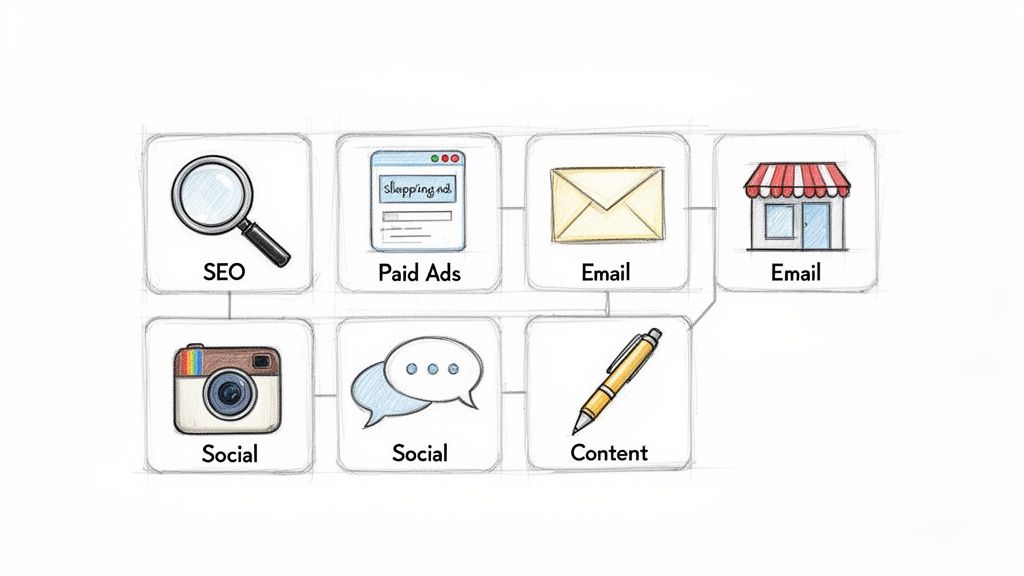
Once you have a solid grasp of your customer journey, it’s time to pick your tools. Think of marketing channels less like a checklist and more like a specialist’s toolkit—each one is designed for a specific job. The goal isn’t to be everywhere at once; it’s to show up in the right places, at the right time, with a message that actually resonates.
Trying to master every channel from day one is a recipe for burnout. Instead, focus your energy on a few core channels, learn their ins and outs, and get a real return on your investment. Let’s walk through the heavy hitters that form the foundation of most successful ecommerce stores.
Search Engine Optimisation (SEO): The Long-Term Growth Engine
SEO is all about making your store more visible when people search for things on Google. It's not a quick fix or an overnight win. Think of it as building a valuable asset that, once it gains momentum, can bring highly qualified traffic to your digital doorstep for years to come, without you paying for every click.
When done right, SEO is an incredibly cost-effective way to attract shoppers who are already looking for what you sell. The bedrock of good ecommerce SEO is understanding the exact keywords your audience is typing into that search bar. Tools like Google Keyword Planner or Ahrefs can help you unearth these terms. You'll want to focus on phrases that signal a clear intent to buy (like “men’s waterproof running shoes size 10” instead of a vague query like “running tips”).
From there, you’ll want to weave these keywords into a few key areas of your site:
- Product Pages: Your product titles, descriptions, and even image alt-text should include your target keywords in a natural, helpful way.
- Category Pages: These are goldmines for broader keywords like “women’s summer dresses.”
- Blog Content: Write genuinely useful articles that answer your customers' biggest questions. This builds trust and attracts people who are just starting their research.
Paid Advertising for Targeted Reach
While SEO is a slow burn, paid advertising is like flicking a switch for instant visibility. It lets you put your products right in front of a hand-picked audience on the platforms they use every single day. This is a fantastic way to drive your first sales, test new product ideas, and quickly learn who your best customers are.
For most ecommerce brands, Google Shopping Ads are a must. These are the visual ads that pop up at the top of search results, showing your product image, price, and store name. Since nearly half of consumers kick off their product hunt on a search engine, according to a 2022 Statista report, getting your products featured here is a direct line to motivated buyers.
Social media platforms are another paid advertising powerhouse. You can target users based on incredibly specific demographics, interests, and past behaviours, making it the perfect place to find your ideal customer. The trick is to create ads that don't feel like ads. They should blend in with the platform, looking more like interesting content than a hard sell.
Email Marketing: The Direct Line to Your Customers
Even after all these years, email marketing consistently delivers one of the highest returns on investment. Why? Because you’re talking to people who have explicitly given you permission to be in their inbox. It’s a direct, personal channel to your most engaged audience.
A smart email strategy is about so much more than just sending a weekly newsletter. It's about building automated sequences, or “flows,” that trigger based on what a user does on your site. This is how you nurture the relationship at every step.
The most powerful ecommerce email campaigns are not one-off blasts but automated conversations. An abandoned cart email that arrives an hour after a visitor leaves is far more effective than a generic weekly promo.
Here are the essential automated emails every store needs:
- Welcome Series: A sequence of 3-4 emails that introduces new subscribers to your brand, shares your story, and maybe offers a small incentive to make that first purchase.
- Abandoned Cart Reminders: A gentle nudge to shoppers who added items to their cart but got distracted. This single automation can claw back a surprising amount of lost revenue.
- Post-Purchase Follow-ups: Send a thank you, provide shipping updates, and later, ask for a product review. This closes the loop and helps you build social proof.
Content and Social Media for Building a Community
Finally, content and social media are where you stop being just a store and start building a real brand. These channels are for sharing your story, showcasing your values, and creating a community of fans who feel connected to what you’re doing. This is how you turn one-time buyers into lifelong advocates.
Your content strategy should be built around one thing: providing genuine value. This could be a blog post that helps a customer choose the right product, an Instagram post showing your products being used in real life, or a behind-the-scenes look at how your items are made. Considering that, according to Statista, 60% of people now report buying from brands they discover on social media, the link between engagement and sales is undeniable.
The goal here is to become a trusted resource and a brand people are proud to associate with. That's how you build brand equity—something your competitors can't easily copy.
How Site Speed and Image Quality Drive Sales
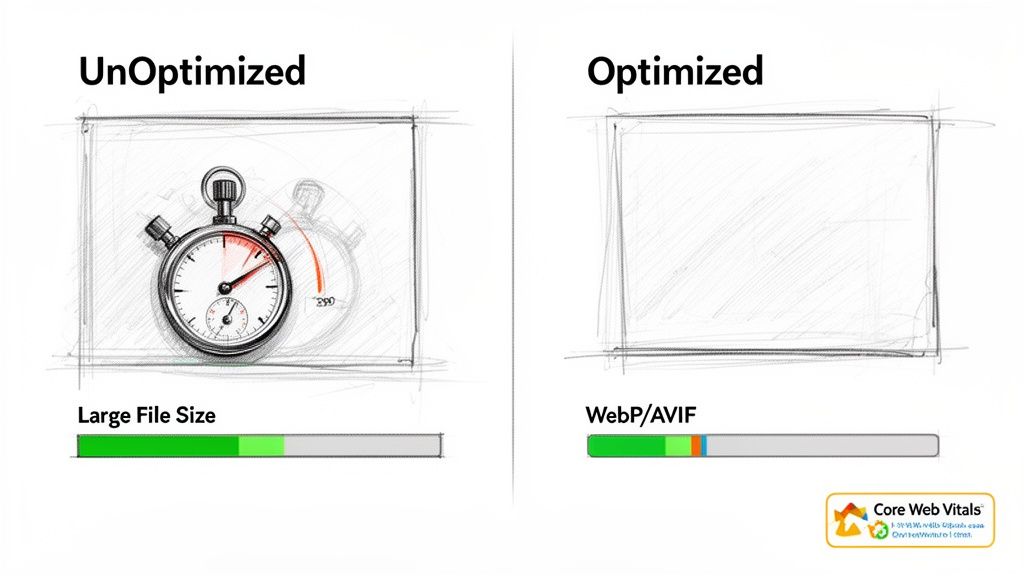
Think about it: all your hard work in marketing—from clever social media campaigns to perfectly crafted emails—funnels customers to one place: your website. If that destination is slow, clunky, and frustrating, you’ve lost the sale before they even see a single product. In the world of marketing for ecommerce, your site’s technical performance isn't just an IT problem; it's one of your most powerful marketing levers.
A fast, responsive online store builds instant trust and keeps shoppers clicking. A slow one is the silent killer of conversions. Every fraction of a second matters, especially on mobile, where patience is thin and expectations are sky-high.
The stakes are immense. A mere 1-second delay in mobile load times can slash conversion rates by up to 20%, according to research by Think with Google. That’s a staggering hit to your bottom line, and it proves the undeniable link between speed and sales.
Getting a Handle on Your Site's Health with Core Web Vitals
To give store owners a clear way to measure what users actually feel, Google introduced Core Web Vitals. You can think of them as a vital signs check for your website, focusing on three key signals that define the user experience.
- Largest Contentful Paint (LCP): How long does it take for the main event—like your hero image or biggest product photo—to appear on screen? A good LCP reassures visitors that things are working.
- First Input Delay (FID): When a user first clicks a button or a link, how quickly does the site react? A low FID means your site feels responsive and snappy, not sluggish.
- Cumulative Layout Shift (CLS): Does your page content jump around while it loads? CLS measures this visual stability, so users don't get frustrated by accidentally clicking the wrong thing.
Nailing these metrics doesn't just make your customers happier. It's also a big deal for SEO. Google uses these signals in its ranking algorithm, so a faster, more stable site can climb higher in search results.
The Biggest Drag on Ecommerce Speed: Your Images
For most online stores, the single biggest culprit behind slow-loading pages is large, unoptimised product images. You absolutely need high-quality visuals—customers want to see crisp, detailed photos before buying. The problem is, those beautiful, high-resolution files are often huge, bringing your page speed to a grinding halt.
This is where modern image formats come in. For years, we’ve relied on JPGs and PNGs, but newer formats deliver the same stunning quality at a fraction of the file size.
Adopting next-gen image formats like WebP and AVIF is one of the highest-impact, lowest-effort changes you can make. It directly improves Core Web Vitals, enhances user experience, and boosts conversion rates—all without sacrificing visual quality.
Formats like WebP and AVIF were built for the web, using far more advanced compression to shrink file sizes dramatically. This means your product pages load faster, your LCP score gets a boost, and your customers get a much smoother journey. The best part? Most modern ecommerce platforms and browsers now fully support them, making the switch easier than ever. You can see just how powerful this is by reading this guide on converting from PNG to the highly efficient AVIF format.
Making this change doesn’t require a developer. By incorporating image optimisation into your workflow—for example, by using a tool to compress your images—you can ensure your site is always running at peak performance. It’s a simple step towards building a faster, more profitable online store.
Measuring What Matters for Sustainable Growth
Great ecommerce marketing isn’t about being busy; it's about being profitable. If you’re not tracking the right data, you’re essentially just guessing where your money is going. The real shift happens when you move from chasing vanity metrics like ‘likes’ and ‘followers’ to focusing on the hard numbers that actually grow your business.
This data-driven mindset is what separates the pros from the amateurs. It lets you see with absolute clarity what’s working, so you can double down on your winners and stop wasting money on channels that just aren’t delivering. It’s the difference between blindly throwing cash at ads and strategically investing in sustainable, long-term growth.
Getting to Grips With Your Core Numbers
Before you can make smart decisions, you need to speak the language of ecommerce performance. These key performance indicators (KPIs) aren't just buzzwords; they're the vital signs of your business.
- Customer Acquisition Cost (CAC): Put simply, how much does it cost you to get a new customer? You calculate this by dividing your total marketing spend over a set period by the number of new customers you brought in.
- Customer Lifetime Value (CLV): This is a forecast of the total revenue you can expect from a single customer over their entire relationship with your brand. A high CLV tells you that customers are sticking around and spending more over time.
- Return on Ad Spend (ROAS): This one’s straightforward: for every pound you put into advertising, how many pounds do you get back in revenue? A high ROAS is a clear signal that your ads are hitting the mark.
The real insight comes when you look at these metrics together. A healthy ecommerce business model always has a CLV that’s significantly higher than its CAC. It means you're making far more from a customer than it cost you to acquire them. If it's the other way around, you’re actually losing money with every sale.
Building Your Measurement Foundation
The first practical step is getting a solid analytics platform in place. Google Analytics 4 (GA4) is the industry standard for a reason, and it’s non-negotiable for any serious ecommerce store. When set up properly, it tracks sales, shows you how users behave on your site, and reveals which channels are sending you the most valuable traffic.
Once you’ve configured GA4 with ecommerce tracking, you can pinpoint exactly which sources—organic search, a specific Instagram campaign, or your weekly newsletter—are actually driving sales. This data becomes the bedrock of your strategy, allowing you to identify which channels bring in customers with the highest average order value or the best lifetime value.
Understanding the numbers is crucial for growth. Data from Google Analytics doesn't just show you what happened; it provides a roadmap for what you should do next, turning guesswork into a clear, actionable strategy.
Solving the Attribution Puzzle
As your brand grows, you'll realise that customers rarely buy on their first visit. They might see an ad on Instagram, click a link in an email a week later, and finally search for your brand on Google to make a purchase. So, who gets the credit?
This is the classic attribution modelling challenge. Different models tell different stories:
- Last-Click Attribution: Gives 100% of the credit to the final touchpoint before the sale. It’s simple, but it completely ignores all the earlier interactions that built awareness.
- First-Click Attribution: Gives all the credit to the very first touchpoint. This is useful for understanding which channels are best at introducing new people to your brand.
- Data-Driven Attribution (DDA): This is the smartest model, available in GA4. It uses machine learning to analyse the entire customer journey, assigning credit to each touchpoint based on its actual contribution to the conversion.
Choosing the right model helps you see the complete picture of your marketing efforts. It stops you from accidentally cutting the budget for a channel that’s critical at the beginning of the customer journey, even if it doesn't directly close the sale.
For a deeper look into the technical aspects that impact user experience and conversions, you might be interested in our guide on mastering First Contentful Paint. Ultimately, by tracking what truly matters, you can invest confidently in the strategies that fuel profitable growth.
Essential Ecommerce Marketing Metrics
To get started, it's wise to focus on a handful of KPIs that give you the clearest picture of your store's health. The table below summarises the metrics that every ecommerce marketer should have on their dashboard.
| Metric | What It Tells You | Why It's Critical |
|---|---|---|
| Customer Acquisition Cost (CAC) | The average cost to gain one new customer. | Ensures your marketing spend is efficient and you aren't paying too much for new business. |
| Customer Lifetime Value (CLV) | The total revenue you can expect from a single customer over time. | Highlights customer loyalty and the long-term value of your marketing efforts. A high CLV is a sign of a healthy brand. |
| Return on Ad Spend (ROAS) | The revenue generated for every pound spent on advertising. | Directly measures the profitability of your ad campaigns, allowing you to scale what works and cut what doesn't. |
| Conversion Rate | The percentage of website visitors who make a purchase. | A key indicator of how effective your website design, product pages, and overall user experience are at closing sales. |
| Average Order Value (AOV) | The average amount a customer spends per transaction. | Increasing AOV is a powerful way to boost revenue without needing more traffic. It shows the effectiveness of upselling and cross-selling. |
By consistently monitoring these numbers, you move beyond hoping for success and start engineering it. This is how you build a resilient, profitable ecommerce brand.
Common Questions About Ecommerce Marketing
Diving into the world of marketing for ecommerce can feel a bit overwhelming, and it's natural to have a lot of questions. Let's tackle some of the most common ones I hear from store owners to help you get on the right track.
How Much Should I Spend on Ecommerce Marketing?
This is the classic "how long is a piece of string?" question, but there's a solid rule of thumb to get you started. Most businesses aim for a marketing budget that's somewhere between 5% and 15% of their total revenue.
If you're a new store just getting off the ground, you'll likely be on the higher end of that scale—you have to invest to build brand awareness and win over those first crucial customers. On the flip side, an established brand with a loyal following and strong organic traffic might find they can spend less. The smartest play is to start small, watch your Return on Ad Spend (ROAS) like a hawk for every channel, and then pour more fuel on the fires that are burning brightest.
What Is the Most Important Channel for a New Store?
There’s no magic bullet channel that works for everyone, but I’ve seen one combination work wonders for new stores time and time again: foundational SEO combined with laser-focused social media ads. Think of SEO as your long-term investment; it’s what will bring you free, highly motivated buyers from search engines down the line.
But you also need sales now. That's where platforms like Instagram or Facebook come in. They let you get in front of your ideal customers almost instantly, helping you generate those first sales and, just as importantly, gather precious data about who's buying from you. This two-pronged attack gives you both immediate momentum and a plan for sustainable growth.
How Can I Quickly Improve My Conversion Rate?
If you're looking for quick wins, focus on the low-hanging fruit that has the biggest impact. First, your product images. They need to be crystal clear and professional, but they also have to load in a flash. One of the best tricks is to use modern image formats; for example, you can easily convert PNG images to WebP to slash file sizes without sacrificing quality.
Next, streamline your checkout. Every single field or extra click is a potential reason for someone to abandon their cart, so be ruthless and cut it down to the bare essentials. Finally, sprinkle social proof everywhere. Display customer reviews and testimonials prominently on your product pages. These small tweaks reduce friction and build the trust needed to get a shopper to click "buy".
Ready to deliver lightning-fast, visually stunning images that boost your conversion rates? Pixel-Fiddler optimises every image on the fly, ensuring a perfect experience on any device. Start improving your site speed and sales today by exploring our powerful image API at https://pixel-fiddler.com.